
By Planora Imaging Centre, Pune Category: Patient Education | Reading time: 5 min
When it comes to OPG vs CBCT, many patients are unsure which dental X-ray they actually need. Both are common in dentistry, but they serve very different purposes. In this guide, we break down the key differences in simple terms — so you and your dentist can make the right choice.
What is an OPG X-ray?
OPG stands for Orthopantomogram. It is sometimes called a panoramic X-ray or a dental panoramic radiograph.
An OPG takes a single wide X-ray image that captures:
- All your upper and lower teeth
- Both jaws (upper and lower)
- The temporomandibular joints (your jaw joints)
- The nasal area and sinuses
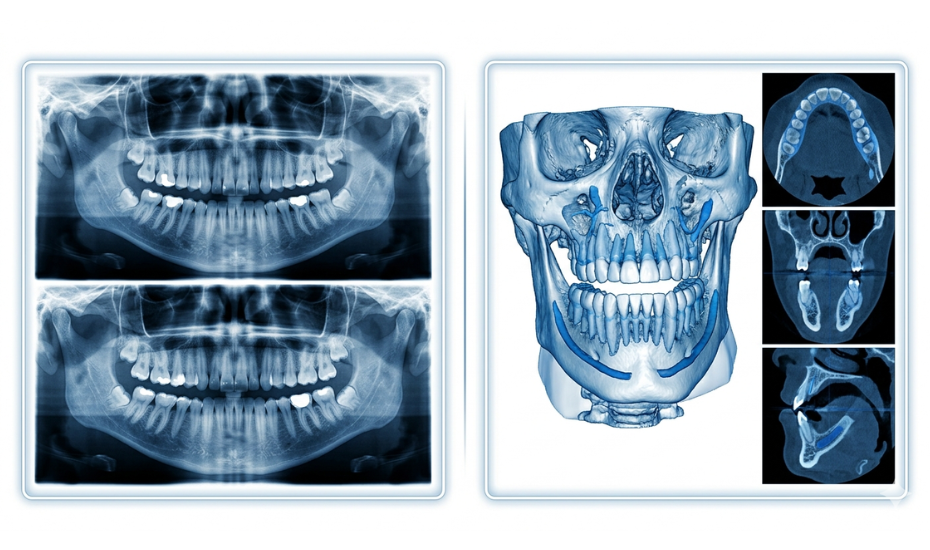
Think of it as a full-picture overview of your entire mouth and jaw in one flat image — similar to a wide-angle photograph.
How is an OPG taken?
The process is simple and takes less than a minute. You stand in front of the OPG machine, bite gently on a small plastic bite piece, and stay still while the machine rotates around your head. There is no pain involved and no injections.
When is an OPG needed?
Your dentist may refer you for an OPG if they need to:
- Plan for a dental implant
- Assess wisdom teeth before removal
- Check the overall alignment of teeth for orthodontic treatment (braces)
- Evaluate bone loss in gum disease
- Get a general overview of your dental health
An OPG is the most common dental X-ray and is suitable for a wide range of routine and specialist situations.
What is a CBCT scan?
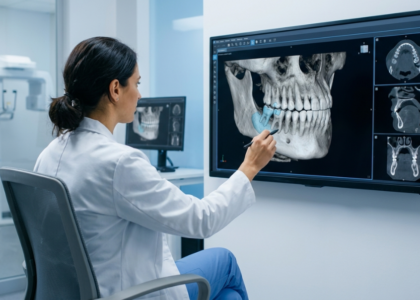
CBCT stands for Cone Beam Computed Tomography. It is a type of 3D X-ray that produces detailed three-dimensional images of your teeth, jaw, bone, and surrounding structures.
Unlike an OPG which produces a flat 2D image, a CBCT scan gives your dentist a complete 3D model — they can view your anatomy from any angle, measure exact distances, and see structures that overlap or are hidden on a regular X-ray.
How is a CBCT scan taken?
Like an OPG, you simply stand or sit while the machine rotates around your head. The scan takes between 10 and 40 seconds depending on the area being scanned. It is completely painless.
When is a CBCT scan needed?
CBCT is recommended when your dentist needs more detailed information than a 2D X-ray can provide. Common situations include:
- Dental implant planning — to measure exact bone height, width and density before placing an implant
- Root canal retreatment — to identify complex root anatomy, missed canals or fractures
- Impacted teeth — particularly wisdom teeth or canines that are buried in the bone
- Jaw joint (TMJ) problems — to assess the joint in 3D
- Orthodontic planning — especially for complex cases or skeletal discrepancies
- Sinuses and airway assessment
OPG vs CBCT — Key Differences at a Glance
| OPG | CBCT | |
|---|---|---|
| Image type | 2D (flat) | 3D (volumetric) |
| Scan time | Under 1 minute | 10–40 seconds |
| Detail level | Good overview | High detail |
| Radiation dose | Very low | Low (slightly more than OPG) |
| Best for | Routine assessment | Complex planning |
| Cost | Lower | Higher |
Which one do you need, OPG vs CBCT?
The short answer is — your dentist or dental specialist decides based on your clinical situation.
In many cases, an OPG is sufficient. It gives a clear overall picture and is the right starting point for most dental assessments. However, when your dentist needs precise measurements, 3D information, or wants to see structures that cannot be clearly seen on a flat image, a CBCT is the better choice.
At Planora Imaging Centre, every scan is reviewed and Dr. Salunke writes every report — an MDS-qualified specialist in Oral Medicine and Radiology. This means your referring dentist does not just receive images — they receive a detailed written report from a specialist, helping them make the most accurate clinical decision for your treatment.
Is the radiation safe?
Both OPG and CBCT use very low doses of radiation. An OPG exposes you to approximately the same amount of radiation as a short-haul flight. A CBCT scan is slightly higher but still considered very safe and well within international guidelines for diagnostic imaging.
At Planora Imaging Centre, we use modern digital equipment that is calibrated to deliver the lowest possible dose while maintaining image quality. Every scan we perform is clinically justified — we never recommend a scan unless it is necessary.
Frequently Asked Questions (OPG vs CBCT)
Can I request a CBCT instead of an OPG? You can request one, but it will be assessed by our specialist. If an OPG is sufficient for your clinical need, we will advise accordingly. We do not perform scans that are not clinically indicated.
How long does it take to get my report? OPG reports are available same day. CBCT reports are typically ready within 24 hours. All reports are written by Dr. Manasi Kajale Salunke — MDS specialist in Oral Medicine and Radiology.
Do I need to do anything to prepare for the scan? No special preparation is required. You will be asked to remove any metal jewellery, glasses or hairpins before the scan.
Can children have OPG or CBCT scans? Yes. OPG scans are commonly performed in children for orthodontic and developmental assessment. CBCT scans in children are performed only when strictly necessary, using the smallest field of view and lowest dose setting.
Where to get your OPG or CBCT in Pune
Planora Imaging Centre is Pune’s dedicated dental radiodiagnostic unit, located at:
214, 2nd Floor, Gera Junction, Borade Nagar, Lullanagar, Pune 411040
We are open Monday to Saturday, 10:30 AM to 7:30 PM.
To book an appointment, call or WhatsApp us on +91 97300 76223.
All scans are reported by a qualified dental radiologist — giving your dentist the clarity they need to treat you with confidence.
Planora Imaging Centre is Pune’s exclusive dental radiodiagnostic unit led by Dr. Manasi Kajale Salunke, MDS — Oral Medicine and Radiology, Government Dental College and Hospital, Mumbai.