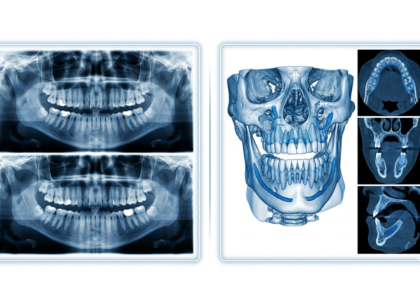

When your dentist sends you for an X-ray or a CBCT scan, you probably assume that whoever reads it knows exactly what they’re looking at. Most of the time, that assumption is correct. But the depth of what they see — and what ends up in your report — can vary significantly depending on who interprets the scan.
This is where a dental radiologist makes all the difference.
What exactly is a dental radiologist?
A dental radiologist — formally known as an Oral Medicine and Radiology specialist, or OMDR — is a dentist who has completed an additional three years of postgraduate training (MDS) specifically in oral and maxillofacial imaging and diagnosis.
They are not general radiologists who happen to read dental scans. They are dentists first, who then specialised entirely in the diagnostic side of dentistry — understanding how disease, pathology and anatomical variation appear on X-rays, CBCT scans, cephalograms and other imaging modalities.
In India, this qualification is an MDS in Oral Medicine and Radiology, typically completed at a dental college or university after the BDS degree.
How is that different from a general radiologist?
A general radiologist is a medical doctor trained to interpret a broad range of imaging — chest X-rays, abdominal CTs, MRI scans of the brain, bone scans and much more. They are highly skilled within their domain.
However, dental anatomy is its own world. The number of root canals in a molar, the proximity of a wisdom tooth root to the inferior alveolar nerve, the trabecular pattern of alveolar bone before implant placement, the subtle periapical changes in a tooth with a failing root canal — these are things that require years of dedicated dental training to recognise and interpret accurately.
A general radiologist may read your CBCT scan and produce a report. But a dental radiologist reads the same scan and tells your dentist things a general report would miss — because they know exactly what the treating dentist needs to know.
What does a dental radiologist actually do?
Beyond reading scans, a dental radiologist’s role includes:
Choosing the right imaging protocol. Not every case needs the same field of view or resolution setting on a CBCT machine. A dental radiologist helps select the correct parameters — keeping radiation dose as low as possible while capturing everything the treating dentist needs.
Writing clinically useful reports. A good radiology report does not just describe what is visible. It answers the clinical question. It tells an implantologist whether there is adequate bone density. It tells an endodontist whether there is a missed canal or a lateral root fracture. It tells an orthodontist where an impacted canine actually sits in three dimensions.
Diagnosing oral pathology. Dental radiologists are also trained in the diagnosis of oral premalignant and malignant conditions — lesions, cysts, tumours and other pathological changes that can appear on imaging. Catching these early on a routine OPG is something that requires a trained eye.
Direct communication with the referring dentist. At a specialist imaging centre like Planora, the radiologist is available to discuss reports directly with the treating dentist. If there is a finding that needs clarification, you speak to the person who read the scan — not a receptionist relaying a message.
Why does this matter for your patient?
Consider two scenarios.
In the first, a patient gets a CBCT scan before implant placement. The report comes back from a general radiology lab — it describes the bone dimensions and mentions no obvious pathology. The implant is placed. Six months later, there is a complication — the bone density was lower than it appeared, and a canal variant near the planned implant site was not flagged.
In the second, the same patient’s scan is read by a dental radiologist. The report notes the bone density, flags the trabecular pattern as suggesting lower density than the measurements alone indicate, and specifically comments on the proximity of anatomical structures in the surgical area. The implantologist adjusts the plan accordingly. The procedure is uneventful.
Both reports came from qualified professionals. But one was written by someone who speaks the same clinical language as the treating dentist.
Who should you refer your patients to?
When referring for dental imaging, look for a centre where:
- The scans are reported by an MDS-qualified Oral Medicine and Radiology specialist
- The reporting radiologist is available for direct communication
- The imaging protocols are selected based on the clinical indication — not a one-size-fits-all approach
- Low-dose imaging protocols are followed as standard
About Planora Imaging Centre, Pune
Planora Imaging Centre is led by Dr. Manasi Kajale Salunke — MDS (Oral Medicine and Radiology), Government Dental College and Hospital, Mumbai. With over 10 years of experience in oral and maxillofacial imaging, Dr. Salunke runs multiple radiodiagnostic units across Pune and has contributed to several peer-reviewed dental journals.
At Planora, every scan — OPG, CBCT, cephalogram, TMJ imaging or Proface — is personally reviewed and reported by Dr. Salunke. Referring dentists can contact her directly for any queries about scan selection, imaging protocols or report interpretation.
Planora Imaging Centre, Pune 📞 +919730076223 📍214, 2nd Floor, Gera Junction, Borade Nagar, Lullanagar, Pune, Maharashtra 411040 🕐 Monday to Saturday, 10:30 AM – 7:30 PM