“Do I really need an X-ray?” and “Is the radiation harmful?” — these are two of the most common questions patients ask before a dental scan. They are completely valid questions, and you deserve a straight, honest answer.
The short version: yes, dental X-rays involve a small amount of radiation. But the doses used in modern dental imaging are extremely low — and in most cases, the risk of not having the scan far outweighs any risk from the radiation itself.
Here is everything you need to understand about dental X-ray radiation, explained clearly.
What is radiation, and why is it used in dental imaging?
Radiation is energy that travels through space. X-rays are a form of radiation that can pass through soft tissue but are absorbed by denser structures like bone and teeth — which is exactly what makes them useful for imaging. The differences in how X-rays pass through different structures create the image your dentist or radiologist reads.
The concern patients have is about ionising radiation — the kind that, at very high doses, can damage cells. This is the same type used in medical CT scans, airport security scanners and, in much larger doses, radiation therapy for cancer.
The key word here is dose. Radiation risk is entirely about the amount of exposure. And dental X-ray doses are among the lowest of any medical imaging procedure.
How does the radiation dose from dental X-rays compare?
To put things in perspective, here are approximate radiation doses for common exposures:
- Single dental X-ray (periapical): 0.005 mSv
- OPG panoramic X-ray: 0.01 – 0.02 mSv
- Dental CBCT scan: 0.05 – 0.2 mSv (depending on field of view)
- Medical chest X-ray: 0.1 mSv
- Medical CT scan of the head: 1–2 mSv
- Natural background radiation (India, per day): approximately 0.007 mSv
An OPG X-ray exposes you to roughly the same amount of radiation you receive from natural background sources in a single day. A CBCT scan, which gives far more detailed 3D information, is still significantly lower than a standard medical CT scan.
Put simply — the dental X-rays and scans your dentist recommends are, in terms of radiation, among the safest medical procedures available.
What is the ALARA principle?
At responsible imaging centres, every scan is guided by a principle called ALARA — As Low As Reasonably Achievable. This means the goal is always to use the lowest radiation dose that still produces a diagnostically useful image.
In practice, ALARA means:
- Selecting the correct field of view for a CBCT scan — scanning only the area that needs to be assessed, not the entire head
- Using the appropriate resolution setting — high resolution is not always necessary and increases dose
- Calibrating equipment regularly to ensure it is performing efficiently
- Not repeating scans unnecessarily
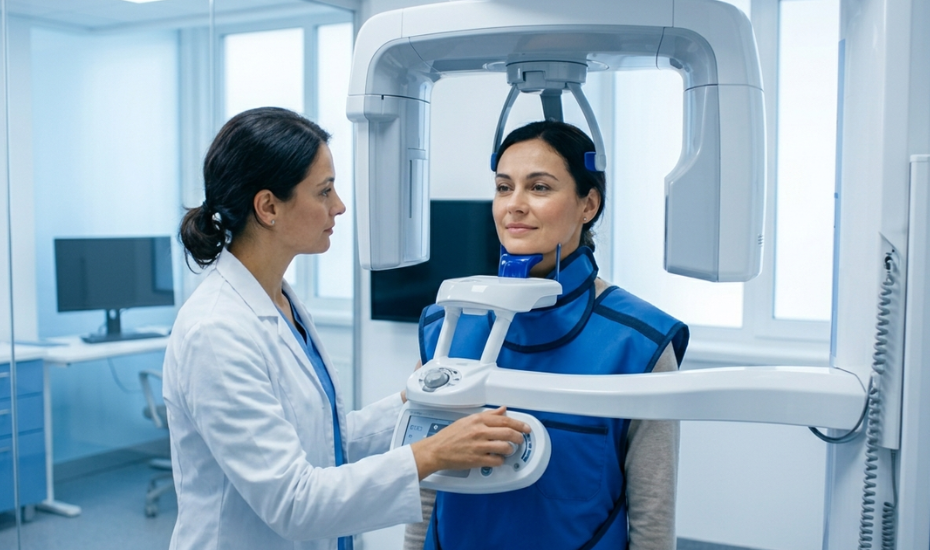
- Using lead aprons when appropriate, especially for children and pregnant patients
At Planora Imaging Centre, low-dose protocols are standard practice on every scan — not an optional extra.
Are some people at higher risk than others?
For most adults, the radiation from routine dental X-rays poses no meaningful health risk. However, extra caution is applied in certain situations:
Children have developing tissues that are more sensitive to radiation. Dental X-rays for children should always use the smallest possible field of view and lowest appropriate dose. At Planora, paediatric cases are handled with specific low-dose protocols.
Pregnant patients are generally advised to avoid non-essential X-rays during pregnancy, particularly in the first trimester. If imaging is genuinely necessary, it can be performed safely with appropriate shielding. Always inform the radiographer and radiologist if you are pregnant or think you might be.
Patients requiring frequent imaging — for example, those undergoing complex orthodontic treatment or multiple implant procedures — should discuss the cumulative exposure with their dentist and radiologist. A good dental radiologist will always help select the minimum imaging necessary to answer the clinical question.
Should you refuse an X-ray your dentist recommends?
This is a decision only you can make, but consider this: the purpose of a dental X-ray is to give your dentist information they cannot get any other way. Without that information, treatment decisions are made with less certainty — which can lead to missed diagnoses, unexpected complications during procedures, or treatment that does not achieve the best possible result.
The radiation from a dental X-ray is small. The consequences of proceeding without adequate imaging can sometimes be significant.
If you are ever unsure whether a scan is necessary, it is completely reasonable to ask your dentist: “What clinical decision will this scan help you make?” A good dentist — and a good dental radiologist — will always be able to answer that question clearly.
What makes a dental imaging centre safe?
When choosing where to have your dental X-ray or CBCT scan, look for:
- A centre that follows ALARA protocols as standard
- Equipment that is regularly serviced and calibrated
- A reporting specialist — ideally an MDS Oral Medicine and Radiology specialist — who selects imaging protocols based on your specific clinical need
- Transparency about radiation dose if you ask
About Planora Imaging Centre, Pune
At Planora Imaging Centre, patient safety is built into every scan. We use high-quality, well-maintained imaging equipment with low-dose protocols on all procedures — OPG, CBCT, cephalogram, TMJ imaging and Proface.
Every scan is reported by Dr. Manasi Kajale Salunke, MDS (Oral Medicine and Radiology), Government Dental College and Hospital, Mumbai — ensuring that the imaging you receive is not only safe, but genuinely useful for your dental treatment.
lanora Imaging Centre is Pune’s dedicated dental radiodiagnostic unit, located at:
214, 2nd Floor, Gera Junction, Borade Nagar, Lullanagar, Pune 411040
We are open Monday to Saturday, 10:30 AM to 7:30 PM.
To book an appointment, call or WhatsApp us on +91 97300 76223.
Have a question about a scan you’ve been referred for? Call us or message us on WhatsApp — we’re happy to explain what the scan involves before your appointment.