
What is a cephalogram? It’s a quick side-view X-ray of your head, often called a “ceph”, that orthodontists use to plan braces and jaw treatment. If your orthodontist has asked you for one, this guide explains what it shows, how the scan works and why it matters.
What is a cephalogram and what does it show?
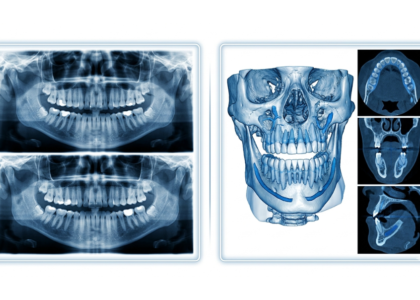
A cephalogram, also called a lateral cephalogram, is an X-ray taken from the side of your head. An OPG shows your teeth and jaws in a wide panoramic view. A cephalogram shows your profile: the skull, the upper and lower jaws, the teeth and the outline of soft tissues such as the lips, nose and chin, all in one image.
The word “cephalometric” comes from the Greek for “head measurement”. Orthodontists use the image to measure how your jaws, teeth and face relate to each other.
Why do orthodontists order one?
To plan braces and aligners. It shows how the upper and lower jaws sit in relation to each other and to the skull, and whether the front teeth are tilted forward or backward. For example, two people with similar-looking crooked teeth can need very different treatment, depending on what lies underneath.
To spot jaw problems. It helps show whether a bite problem comes from the teeth, the jaw bones or both. This matters when deciding between braces alone and a combined approach with surgery.
To plan jaw surgery. For corrective jaw surgery (orthognathic surgery), a cephalogram is a standard part of planning. In addition, surgeons use it together with 3D imaging such as Proface 3D face imaging and, where needed, a CBCT 3D scan.
To track growth in children. In growing children, it can show how the jaws are developing, which helps decide the best time to start treatment.
To check progress. Finally, orthodontists sometimes repeat the cephalogram during or after treatment to compare it with the original.
What does the orthodontist look at?
Your orthodontist or dental radiologist marks key points on the image and measures the angles between them. They call this cephalometric analysis, a standard method in orthodontics (see a general overview of cephalometric analysis). It shows:
- The position of the upper and lower jaw relative to the skull
- The angle of the front teeth
- The shape of your facial profile
- In some cases, the size of the airway space
You don’t need to understand the numbers. Instead, the orthodontist uses them to choose a treatment plan and to explain what to expect.
What happens during the scan?
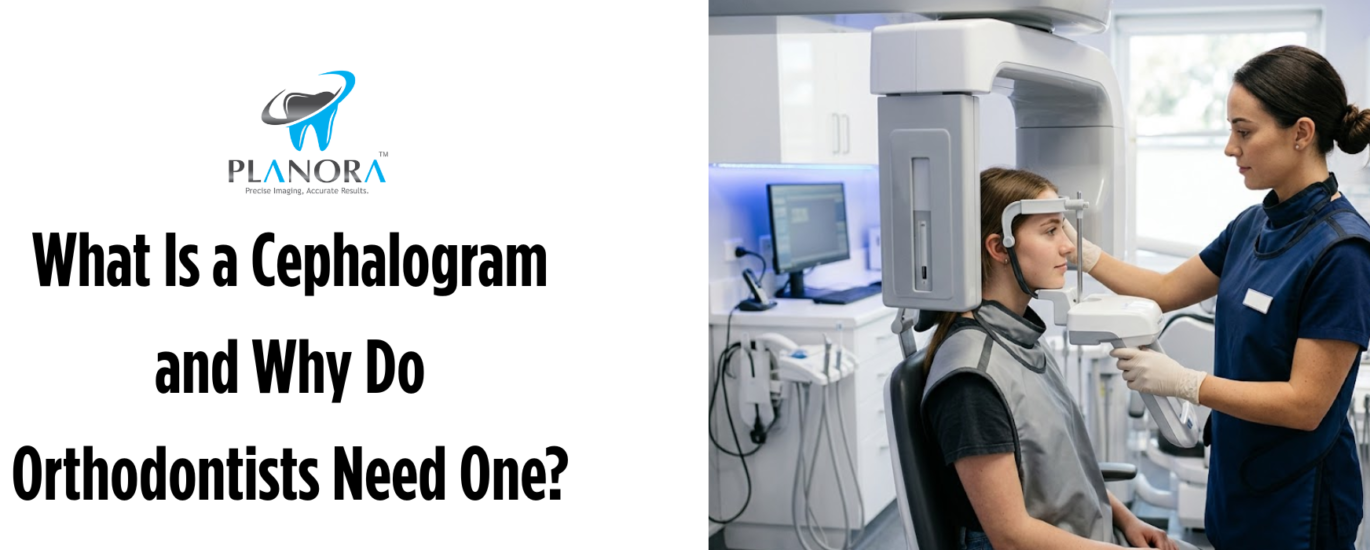
The scan is quick and painless:
- First, the radiographer will ask you to remove jewellery, hairpins and glasses.
- Next, you stand or sit while soft supports at the ears hold your head steady, so it doesn’t move.
- Then you close your teeth in your normal bite and relax your lips.
- Finally, the machine takes the image in a few seconds, and the result appears on screen.
There are no injections and no preparation, so you can go straight back to your day.
Is a cephalogram safe?
Yes. A cephalogram uses a very low dose of radiation, in the same range as other routine dental X-rays, and your dentist or orthodontist orders it only when they need the information. You can read more in our guide to whether dental X-ray radiation is safe. Also, if you are pregnant, tell the team before the scan.
Cephalogram vs OPG vs CBCT
These three scans answer different questions:
- Cephalogram: a side-view profile, mainly for orthodontic and jaw-relationship planning.
- OPG: a full-mouth panoramic view of all teeth, both jaws and the TMJ.
- CBCT: a 3D scan for detailed anatomy such as implants, impacted teeth and nerves.
Many orthodontic patients have an OPG and a cephalogram together at the start of treatment. Sometimes a 3D scan is needed instead. Our guide to OPG vs CBCT explains when.
Frequently asked questions about the cephalogram
What is a cephalogram used for in simple words?
It’s a side-view X-ray that helps your orthodontist see how your jaws and teeth line up, so they can plan braces or jaw treatment.
Does a cephalogram hurt?
No. Nothing touches your teeth or mouth, and you only need to stay still for a few seconds.
How long does it take?
The scan itself takes only a few minutes, from positioning to image.
Do I need a referral?
No, a referral isn’t required, but one from your dentist or orthodontist is helpful. Bring any request note, because it tells the radiologist what your orthodontist wants to see.
Who reports the scan?
At Planora Imaging Centre, an MDS specialist in Oral Medicine and Radiology reports every scan. Learn what a dental radiologist does.
Get a cephalogram in Pune
In short, now you know what a cephalogram is and when it’s needed. Planora Imaging Centre offers lateral cephalogram imaging in Pune, reported by Dr. Manasi Kajale Salunke. We’re open Monday to Saturday, 10:30 AM to 7:30 PM. To book, WhatsApp or call +91 97300 76223, or visit the contact page.